
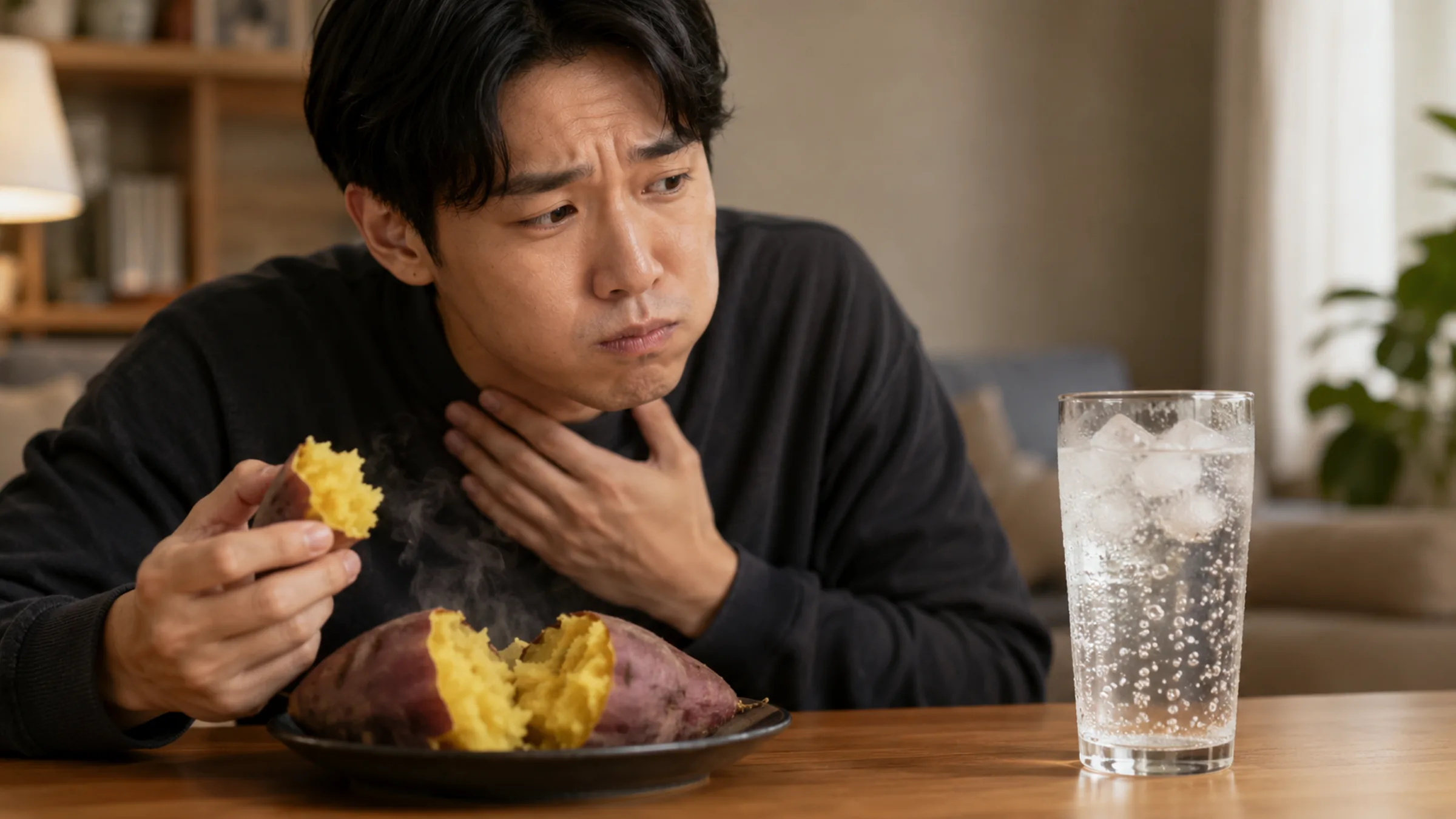
Have you ever eaten steamed sweet potato without water?
It tastes good.
But if you keep eating it, it gets dry and starchy.
It feels like your throat is getting blocked.
It is frustratingly stuffy.
And then you take a sip of cold saida?
Kya.
Everything opens right up.
On the Korean internet, goguma and saida are almost exactly this feeling.
“Ugh, this is goguma”
You are watching a drama, and the protagonist has been falsely accused.
They more or less know who the culprit is.
There is evidence too.
All they have to do is say it.
But they do not speak.
“No, that’s not it…”
Then they close their mouth again.
The other person misunderstands.
The misunderstanding keeps going through episodes 2, 3, and 4.
The viewer goes crazy.
“Ugh, this is goguma.”
It does not mean someone ate a sweet potato here.
It means a situation that feels as frustrating as having your throat clogged while watching it.
It feels like speaking would solve it, but they do not speak.
It feels like one step would solve it, but they keep standing in the same place.
They keep misunderstanding something that would end if they simply talked to each other.
That is when Koreans call it goguma.

Why sweet potato of all things?
Steamed sweet potato is delicious.
But if you keep eating it without water, it gets dry and starchy.
Your mouth dries out.
Your throat feels tightly clogged.
So for a long time in Korean,
“It feels frustrating, like I ate sweet potato.”
has fit naturally as a sensory comparison.
On the internet, this was shortened even further.
Frustrating.
→ Feels like goguma.
→ Goguma.
So expressions like these sound natural too.
“This drama has way too much goguma.”
“Why is the protagonist so goguma?”
“Wow, it feels like I ate 100 sweet potatoes.”
The more sweet potatoes you add, the more the frustration rises with them.
One sweet potato.
A little frustrating.
100 sweet potatoes.
Please, somebody just say something.
A person can be goguma too
It is not only situations that can be goguma.
People can be too.
Your friend likes someone.
It is obvious that the other person likes your friend too.
Only the two of them do not know.
Your friend says:
“They do contact me every day… but I guess we’re just close friends, right?”
The person listening next to them:
“Ah, you are seriously goguma.”
It does not mean your friend looks like a sweet potato.
It means they are acting frustratingly.
Another person might not say anything even when a problem comes up.
Even if you offer to help, they say they are fine.
Then the problem gets bigger.
In that situation too:
“Ah, seriously, what a goguma.”
works.

Not everything sad is goguma
There is an important distinction here.
The protagonist’s family member dies.
It is sad.
You cry.
But that by itself is not goguma.
For something to be goguma, there has to be frustration.
For example, the protagonist gets sick.
It is sad.
Up to this point, it is simply a sad story.
Then the protagonist thinks:
“If I tell them, they’ll worry, so I shouldn’t tell anyone.”
The partner sees the protagonist suddenly avoiding them and thinks:
“Did they stop liking me?”
The two misunderstand each other for six episodes.
The viewer already knows everything.
Now it is goguma.
It is not the sadness.
“Why do they keep refusing to solve something that one sentence would clear up?”
That is what creates goguma.
Then saida appears
A villain keeps abusing their power at work.
They blame an employee for their own mistake.
The protagonist keeps putting up with it.
The viewer is now on about sweet potato number 50.
A meeting starts.
The villain says again:
“This is entirely that employee’s responsibility.”
Then the protagonist turns the laptop around.
Email records.
A recording.
The date the order was given.
It is all there.
And one sentence.
“You gave this order yourself, manager.”
Silence.
The villain’s face freezes.
Wow, damn, saida.
That is saida.
Korean saida is a drink like Sprite
This is where overseas readers get confused once more.
If you think of English cider, an apple drink or alcoholic cider may come to mind first.
That is not what everyday Korean saida means.
Think of a clear, sweet, carbonated drink like Sprite.
It does not refer to one specific brand either.
In Korea, clear carbonated drinks of this kind have long been called saida.
So when your throat gets clogged while eating sweet potato,
the scene of taking a sip of cold saida connects perfectly.
Dry and starchy.
Frustratingly clogged.
Take a sip.
The carbonation bursts.
Kya.
That frustrating blockage goes down.
So
frustration = goguma
a satisfyingly refreshing release = saida
became a pair.
Saida does not simply mean “the problem got solved”
This matters too.
Not every problem being solved in a drama is saida.
For example, the villain quietly gets transferred to another department.
The problem is solved.
But the satisfying release viewers were waiting for may be missing.
Saida usually needs
“Yes. This is what I wanted to see.”
That feeling has to be there.
A person who kept abusing others gets publicly caught in their own lie.
The protagonist who was treated unfairly puts the evidence down.
People finally learn the truth.
The villain cannot say a word.
Saida.
It is not just a solution.
The blocked-up emotion has to open up too.
That is why there is also a “saida remark”
Saida does not refer only to scenes.
It can also attach to words.
Someone says on everyone’s behalf what everybody wanted to say but could not.
A boss makes an absurd demand.
The meeting room is silent.
One person says:
“If that is the schedule, you need to give us more people. It is impossible with the current staff.”
Everyone thinks to themselves:
Yes. That.
Something like this
“saida remark.”
can be called that.
One sentence releases the stifling atmosphere.
So even in dramas, the range expands into expressions like
saida scene.
saida development.
saida character.
saida remark.
That is how the expression expands across a wider range.
Goguma and saida move almost like opposites
The goguma keeps piling up.
The protagonist is frustrating.
People do not speak.
The villain keeps winning.
The misunderstanding does not get cleared up.
Then comments appear.
“Way too much goguma.”
“Feels like I ate 100 sweet potatoes.”
And at some point the protagonist finally fights back properly.
The comments change.
“Wow, saida.”
“Finally, some saida.”
The two are almost a set.
Goguma blocks you up, and saida clears you out.
So some of the feeling disappears in translation
In English, a goguma situation can be translated as
frustrating
stifling
painfully frustrating
or something similar.
A saida scene can be
satisfying
refreshing
cathartic
and so on.
The meaning comes across.
But Korean contains the physical sensation of the food and drink too.
Eat sweet potato.
Your throat gets blocked.
Drink saida.
Everything opens up.
So instead of memorizing the two separately,
it is much easier to remember them as one scene.
In the end, this is all you need to remember
You saw a sad scene.
Goguma? Not necessarily.
A problem got solved.
Saida? Not necessarily.
If the person watching becomes
“Ah, this is so frustrating I’m going crazy,”
that is goguma.
And if that frustration gets satisfyingly blown open with
“Yes! That’s exactly it,”
that is saida.
So if you see a Korean drama comment saying
“It feels like I ate 100 sweet potatoes.”
do not be surprised.
Nobody ate 100 sweet potatoes.
The viewers want one thing.
Give us some saida.
Sources
- Yonhap News — “Frustrating situations are ‘goguma,’ refreshing ones are ‘saida’… everyday language changes” — National Institute of Korean Language 2025 language-use survey: 56.8% said they use goguma for frustrating situations or people, and 71.5% said they use saida for situations that feel satisfyingly refreshing / 2026-02-05 / checked 2026-08-15
- Reddit r/Korean — “Help with a slang(?) term: 사이다 발언” — example of an overseas learner asking about
사이다 발언, with an explanation connecting the dry texture of sweet potato and the refreshing feeling of saida / checked 2026-08-15 - Reddit r/Korean — “Where did 사이다 come from?” — example explaining goguma in K-dramas as frustrating development and saida as a satisfyingly resolved development / checked 2026-08-15