
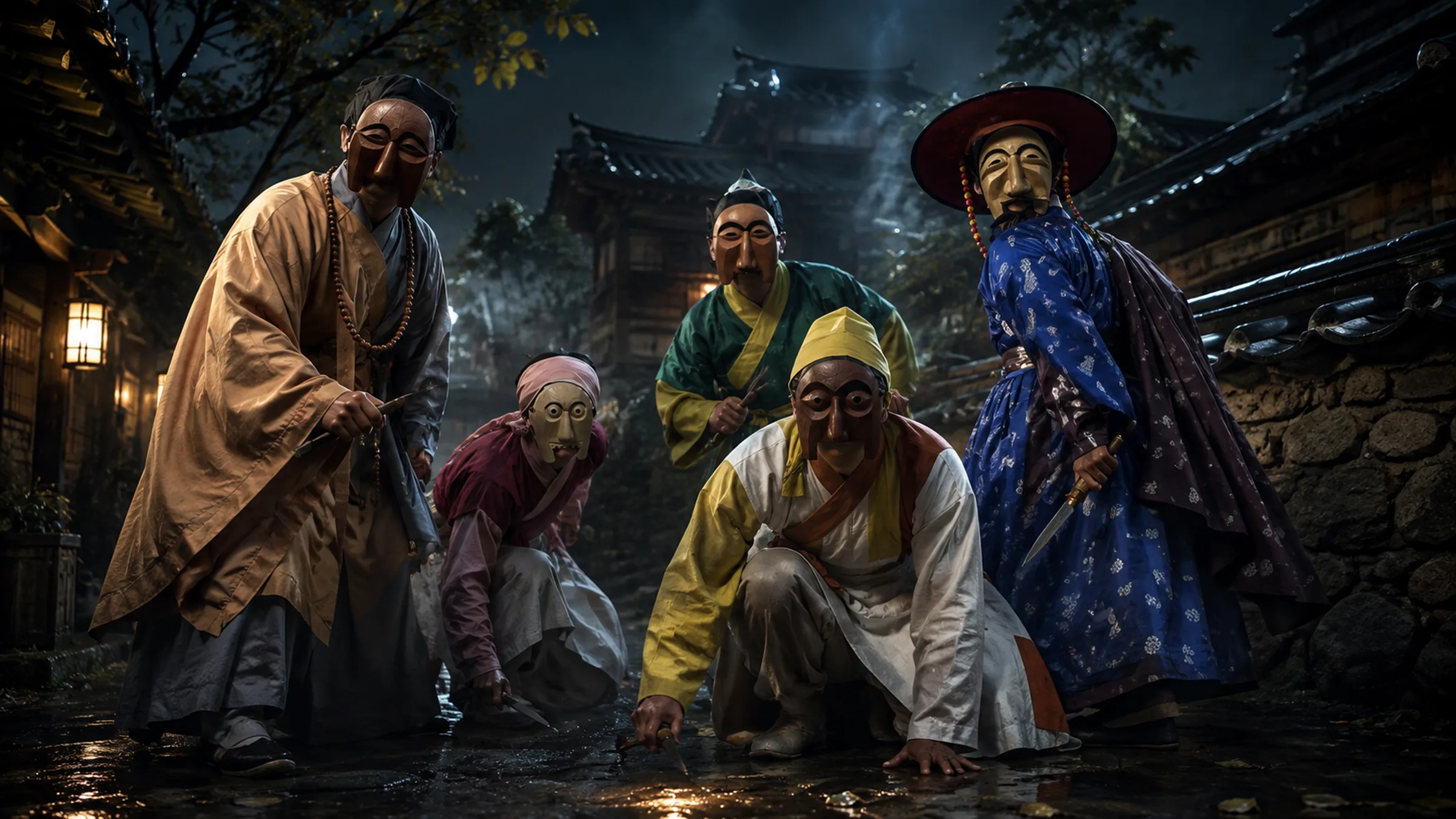
To me, the most beautiful fireworks in the world are in Andong, Korea.
They are not launched high into the sky.
There is no deafening explosion.
Thousands of shells do not burst all at once.
Instead, as darkness settles over the Nakdong River, tiny points of fire begin to appear one by one.
Small sparks drift downward along long ropes stretched between Buyongdae Cliff and the Mansongjeong pine grove.
At first, there are only a few lines.
Then, at some point, a huge curtain of fire forms above the river.
It sways in the wind, the embers fall slowly, and their light trembles again on the water below.
And then people suddenly shout.
“Nakhwa-ya!”
A large mass of fire drops from the top of the cliff.
When it strikes the rocks, it scatters into countless smaller lights.
To some people, they are sparks drifting through the air.
To others, they are flower petals fluttering down.
That scene is why I think Andong is one of the places in Korea everyone should see at least once.
Hahoe Seonyu Julbulnori.
To me, this is where you can see the most beautiful fireworks in the world.
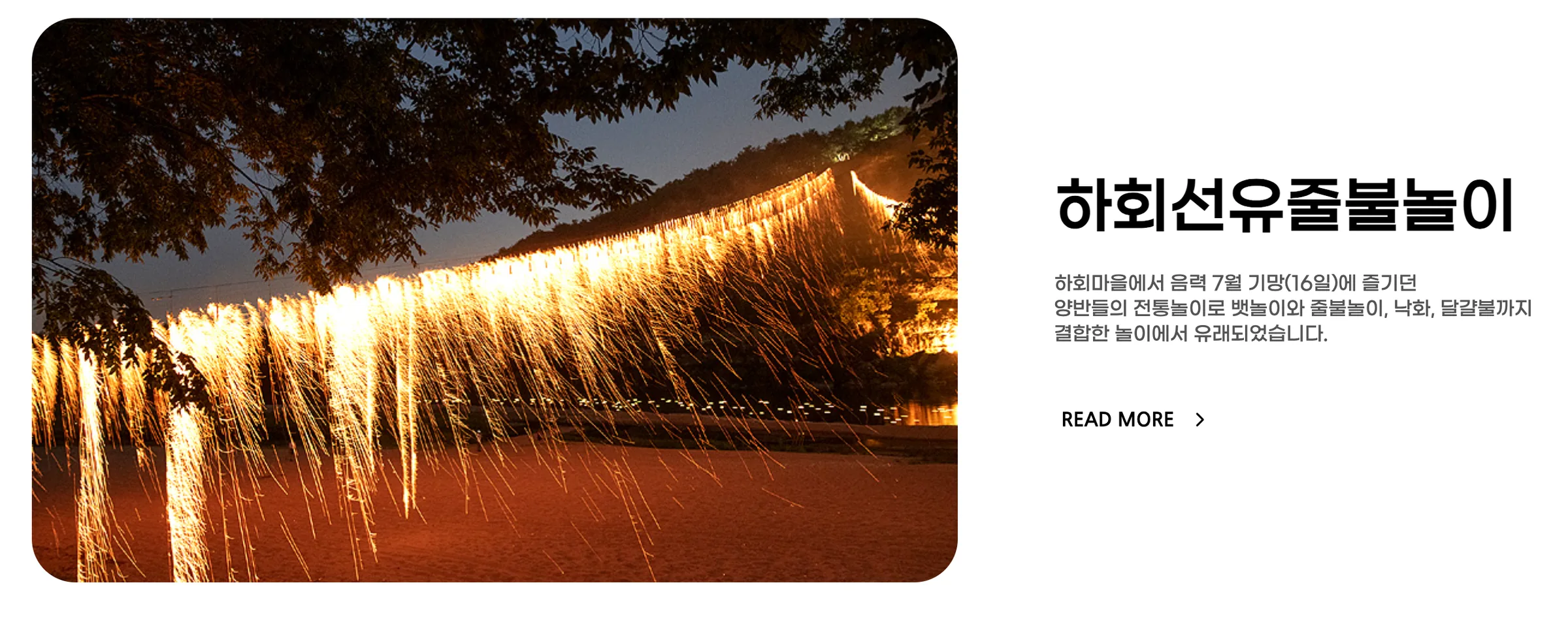
Traditional Korean fireworks do not always explode in the sky
Hahoe Seonyu Julbulnori uses the Nakdong River, Buyongdae Cliff and Mansongjeong in Andong Hahoe Village as one enormous stage.
The city of Andong describes it as a traditional culture of pungryu—scholarly leisure and artistic enjoyment—and a fire spectacle enjoyed by the literati of Hahoe Village for roughly 450 years. In today’s performance, julbul, nakhwa, floating lights on the river and seonyu on boats all come together in a single scene.
The first thing that catches your eye is julbul, the lines of fire.
Long ropes are stretched between Buyongdae and Mansongjeong, and small pouches filled with charcoal powder are attached to them.
When lit, they do not explode all at once like modern fireworks.
They burn slowly.
And they keep releasing very small embers downward.
From a distance, it looks less like sparks falling and more like rain made of light.
Below is the Nakdong River.
Some embers disappear before they reach the water, while their reflections seem to linger and sway longer than the fire itself.
Fire descends from above,
and below, that fire seems to flow once more.
That is why Hahoe Seonyu Julbulnori is not simply an event for watching fireworks.
It is a landscape that only becomes complete when the river, cliff, pine forest and night are all there together.
Then the boats enter.
This is seonyu.
During the Joseon period, scholars floated boats on the river, composed poetry and enjoyed music, drink and scenery.
Small lights also drift across the water.
And finally, fire falls from Buyongdae.
Nakhwa.
“Nakhwa-ya”
This is something you should hear on site.
People wait.
And when the moment comes for the fire to fall from Buyongdae, everyone calls out together.
“Nakhwa-ya!”
At that moment, a burning bundle drops from the high cliff.
It does not simply fall straight down and disappear.
It breaks apart as it strikes the cliff and rocks.
One large flame becomes dozens, then hundreds of tiny embers scattering into the night air.
Watching it, I do not really want to force the word “nakhwa” into a single meaning.
To some people, it is fire scattering through the air.
To others, it is flower petals drifting down.
Fire is falling, yet it looks as if flowers are shedding their petals.
When you see red embers hover briefly in the wind and then disappear, you understand why people remember this short cry.
“Nakhwa-ya.”
The sound travels across the river.
Buyongdae stands behind it,
the Nakdong River lies in front,
and julbul falls from above like rain.
This is a scene that needs to be seen.
No matter how long the explanation, one video makes the structure clear immediately.
Watch how it works first, and the real thing becomes even more interesting.
On video, the whole frame may appear filled with fire. At the actual site, you also see the darkness between each line of light.
That darkness makes every small ember look sharper.
To me, that is the biggest difference from modern fireworks.
Plan your Andong trip around the Julbulnori date
There is one piece of travel information that matters more than anything else.
Hahoe Seonyu Julbulnori is not performed every day.
Do not book a random date for Andong and assume you can simply add Julbulnori that evening.
Do it the other way around.
Check the Julbulnori schedule first, then build the Andong trip around that date.
In 2026, Hahoe Seonyu Julbulnori was scheduled for a total of ten performances, and Andong currently lists another performance around Buyongdae in Hahoe Village on August 29. Dates and reservation systems can change by performance and by year, so check the latest notices from Hahoe Village and Andong Tourism before you travel.
The first thing to check for this trip is not the hotel.
It is not the rental car either.
Check the Julbulnori ticket first.
Then build everything else around it.
Andong is closer to Seoul than it may seem
For an overseas traveler staying in Seoul, Andong may sound like a distant provincial destination.
By train, it is more manageable than many people expect.
Andong tourism information gives the journey from Cheongnyangni Station to Andong by KTX as about two hours.
So this is the route I recommend.
Seoul Cheongnyangni Station
→ KTX
→ Andong Station
→ Rent a car in Andong
→ Hahoe Village
There is no need to rent a car in Seoul and spend several hours driving from the beginning.
Especially if this is your first time driving in Korea, taking the train to Andong and renting there is much easier than dealing with central Seoul and the expressway all at once.
If possible, rent a car in Andong
Having a car makes an Andong trip much easier.
If Hahoe Village is the only place you plan to visit, a bus can work.
But once you reach Hahoe, you will probably want to see Byeongsan Seowon as well.
Back in town, there is Wolyeonggyo Bridge.
You may want to visit the jjimdak alley.
There is Mammoth Bakery too.
The moment you add even a few stops, the distances begin to matter.
So if you can reserve a vehicle for pickup in Andong, I recommend using a local rental car.
For international travelers, it is sensible to first check large companies such as Lotte Rent-a-Car or SK Rent-a-Car.
Lotte provides English, Japanese and Chinese reservation pages as well as KTX-plus-rental services, and its overseas rental business is connected to the Hertz network. SK Rent-a-Car also provides English reservations and operates foreigner-oriented services linked with AVIS.
The important question is not the company name, but whether a vehicle can actually be picked up in Andong on your travel date.
Check Andong pickup availability on the reservation page first.
If it is available, book it.
If not, combine buses and taxis or check another major rental company.
Foreign visitors who plan to drive in Korea should also confirm in advance what the rental company requires, such as an International Driving Permit, their domestic driver’s license and passport.
And one more thing.
If you plan to drink Andong soju, finish all driving first.
We will come back to that later.
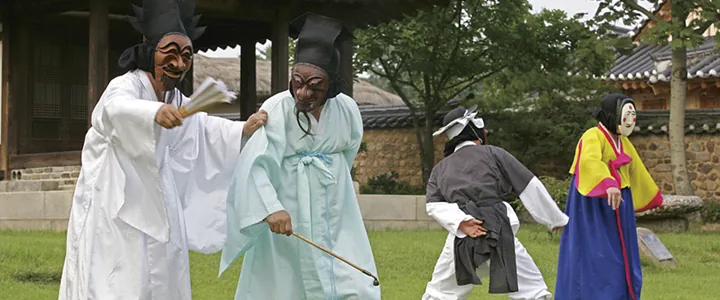
Hahoe is more beautiful at night if you have already seen it by day
You can enter Hahoe Village at night just for Julbulnori.
Still, if possible, go in the daytime first.
Daytime Hahoe feels like a completely different place.
The Nakdong River bends widely around the village, enclosing clusters of tiled-roof and thatched-roof houses.
Across the river is Buyongdae.
Along the river stands the Mansongjeong pine grove.
It is remarkably quiet.
During the day, people look at old houses and walk through narrow lanes.
Then, a few hours later, the sun goes down.
Ropes are stretched between the Buyongdae and Mansongjeong you saw earlier, and fire is lit on them.
Small lights begin to move above what had simply been river water a few hours before.
The cliff becomes a black backdrop.
The same place turns into somewhere completely different.
That is why a Hahoe Seonyu Julbulnori trip is not simply about watching a one-hour performance.
It is about remembering the daytime landscape and then watching that same landscape transform at night.
I think you need to see that whole change to really experience it.
If you have a car, add Byeongsan Seowon
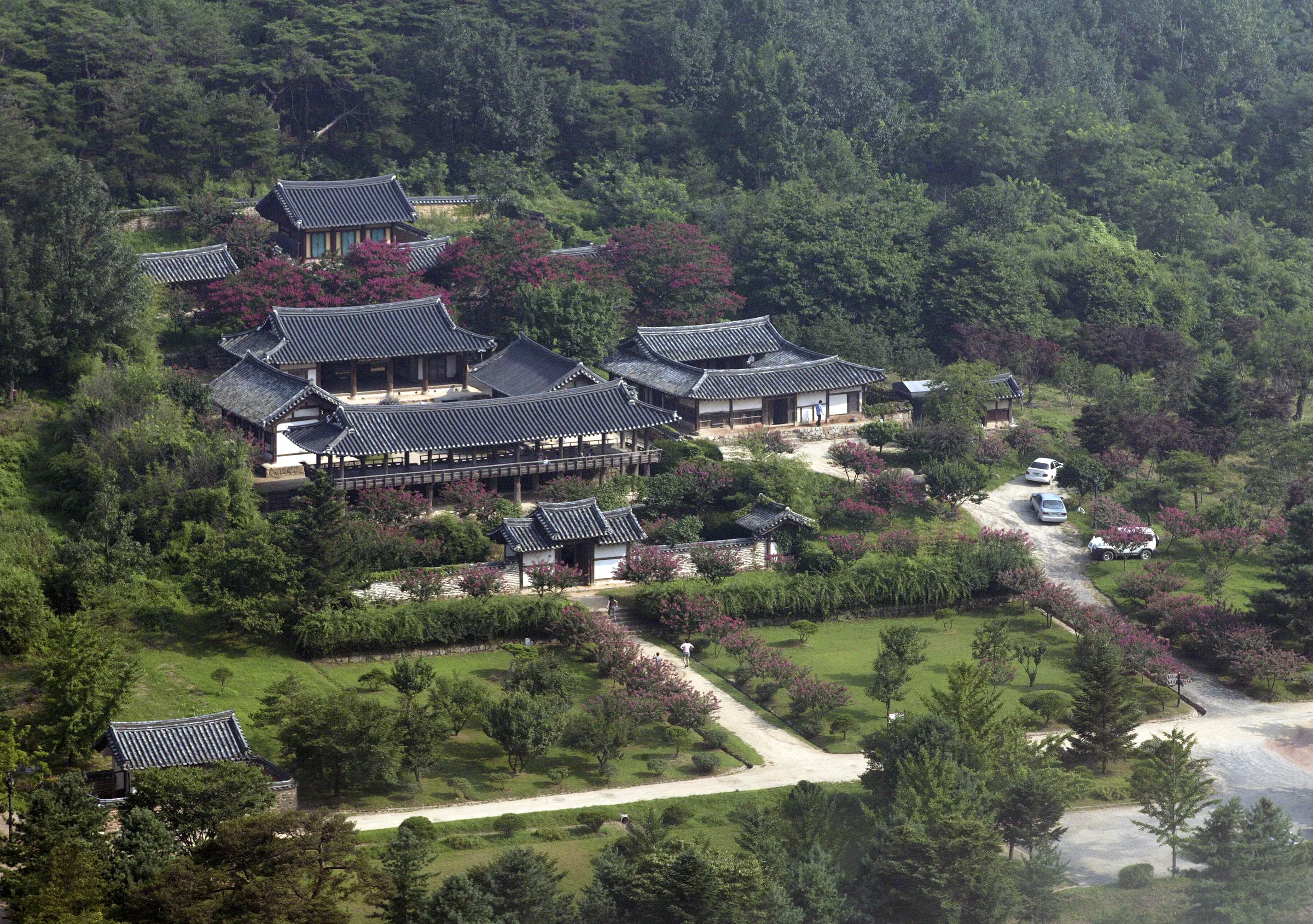
If you choose one more stop around Hahoe Village, make it Byeongsan Seowon.
There is no need to cram every attraction in Andong into one day.
Hahoe Village and Byeongsan Seowon are enough.
The beauty of Byeongsan Seowon is not that its buildings are huge or ornate.
The architecture does not block the scenery.
Sit at Mandaeru Pavilion and look outside, and the Nakdong River and Byeongsan Mountain appear between the columns.
It feels as if the building was constructed for the purpose of looking at the mountain and river.
People often describe Korean traditional architecture in terms of harmony with nature. At Byeongsan Seowon, that phrase stops being a textbook explanation and becomes something visible in front of you.
It is even more interesting together with Hahoe Village.
One is a village where people actually lived,
and the other is a space for scholarship and education.
Then return to Hahoe Village and wait for sunset.
Do not end the day’s sightseeing somewhere else.
End it with the julbul.
What should you eat in Andong?
Andong’s food is a little strange.
In a good way.
It has no sea, yet mackerel is famous.
It is known as a Confucian city, yet huge pots of jjimdak simmer in its market.
Its traditional distilled liquor is famous.
And in between all of that, a bakery founded in 1974 sells thousands of cream-cheese buns a day.
Andong food does not belong to just one historical period.
That is what makes it fun.
Mackerel in a city with no sea
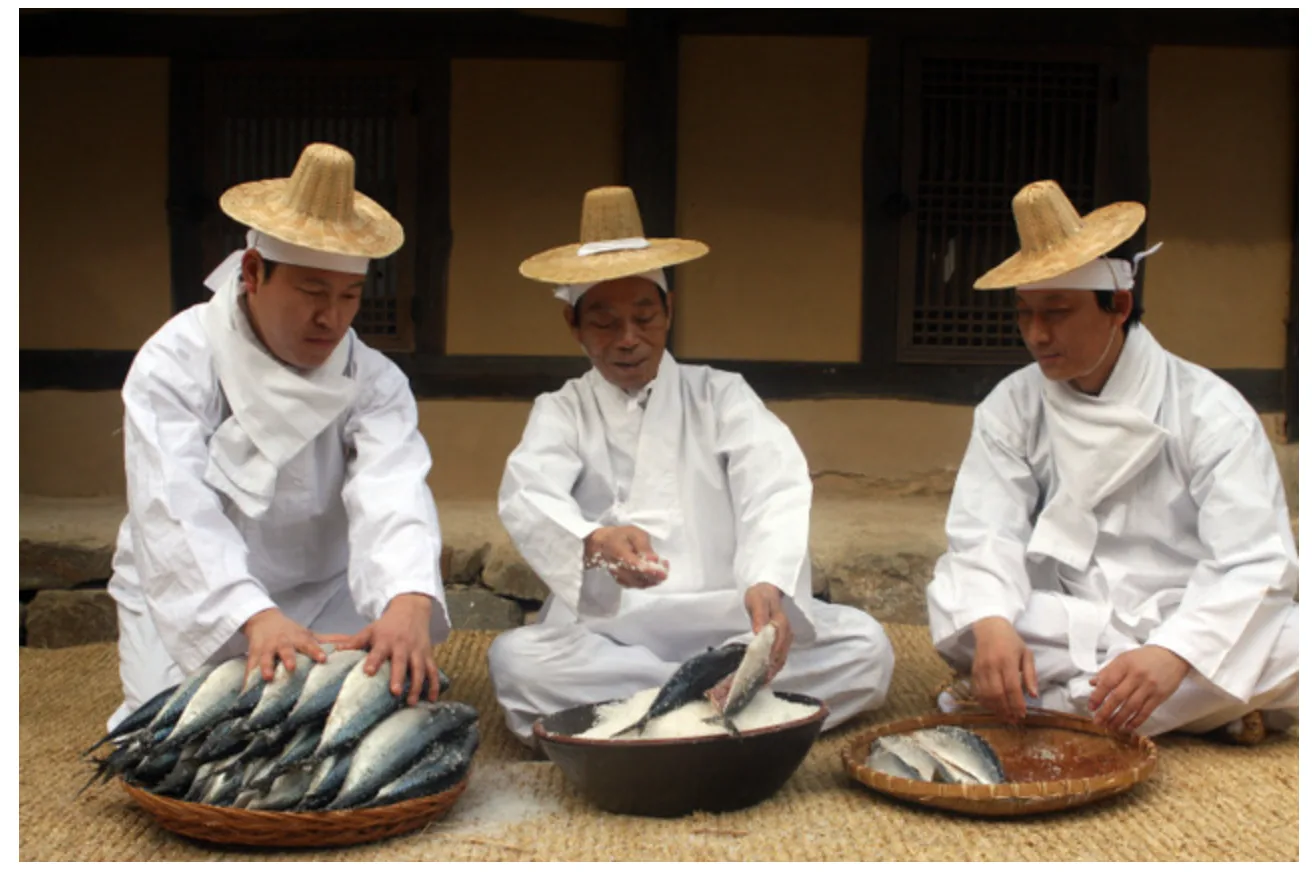
One of Andong’s signature foods is gangodeungeo, salted mackerel.
But Andong is not on the coast.
It is inland.
So a natural question follows.
Why does Andong eat mackerel?
The answer is precisely because the sea was far away.
Before refrigerated trucks and expressways, it took time to transport mackerel caught on the east coast to Andong.
Fish could not simply survive that journey untreated.
Salt was needed.
Mackerel salted during transport and preservation eventually reached Andong tables, and that practice became one of the region’s representative food traditions.
That is what makes Andong salted mackerel interesting.
It did not emerge because the sea was close.
It emerged because the sea was far away.
A geographical inconvenience became a food culture.
Today there is refrigerated distribution.
There is no practical need to preserve fish the same way.
Yet people still eat salted mackerel.
A method that began out of necessity remained because it became flavor and culture.
That is reason enough to eat it when you come to Andong.
Ritual food without a ritual
If you want something that feels even more specifically Andong, try heotjesabap.
The name says exactly what it is.
It is ritual-style food eaten when there is no actual ancestral rite.
Andong has long been a region where Confucian culture remained particularly strong after the Joseon period.
Vegetables, jeon pancakes, meat and other foods placed on ancestral ritual tables naturally became part of local food culture as well.
People also began preparing similar dishes even on days without an actual rite, giving rise to the meal called heotjesabap.
If salted mackerel is a way to eat Andong’s geography,
heotjesabap is closer to eating Andong’s everyday culture.
And now let us change the mood completely.
Andong jjimdak belongs in the market
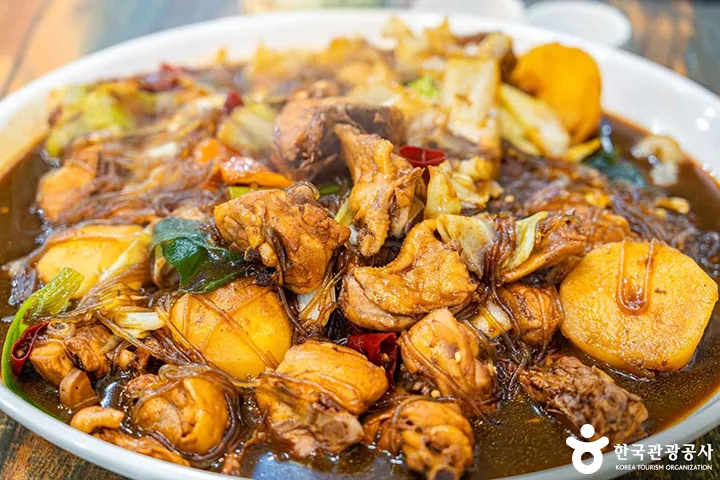
Go to Andong Old Market and you will find Jjimdak Alley.
The city of Andong even presents it as the first stop on one of its downtown food routes.
A large platter arrives with chicken, potatoes, carrots and glass noodles, all covered in a sweet-and-savory soy-based sauce.
It feels completely different from old yangban ceremonial cuisine.
This is food made for several people to sit around and share in a market.
So there is no need to make every meal in Andong belong to the same era.
Eat salted mackerel for lunch,
and jjimdak the next day.
That is real Andong too.
And make sure to try this bun
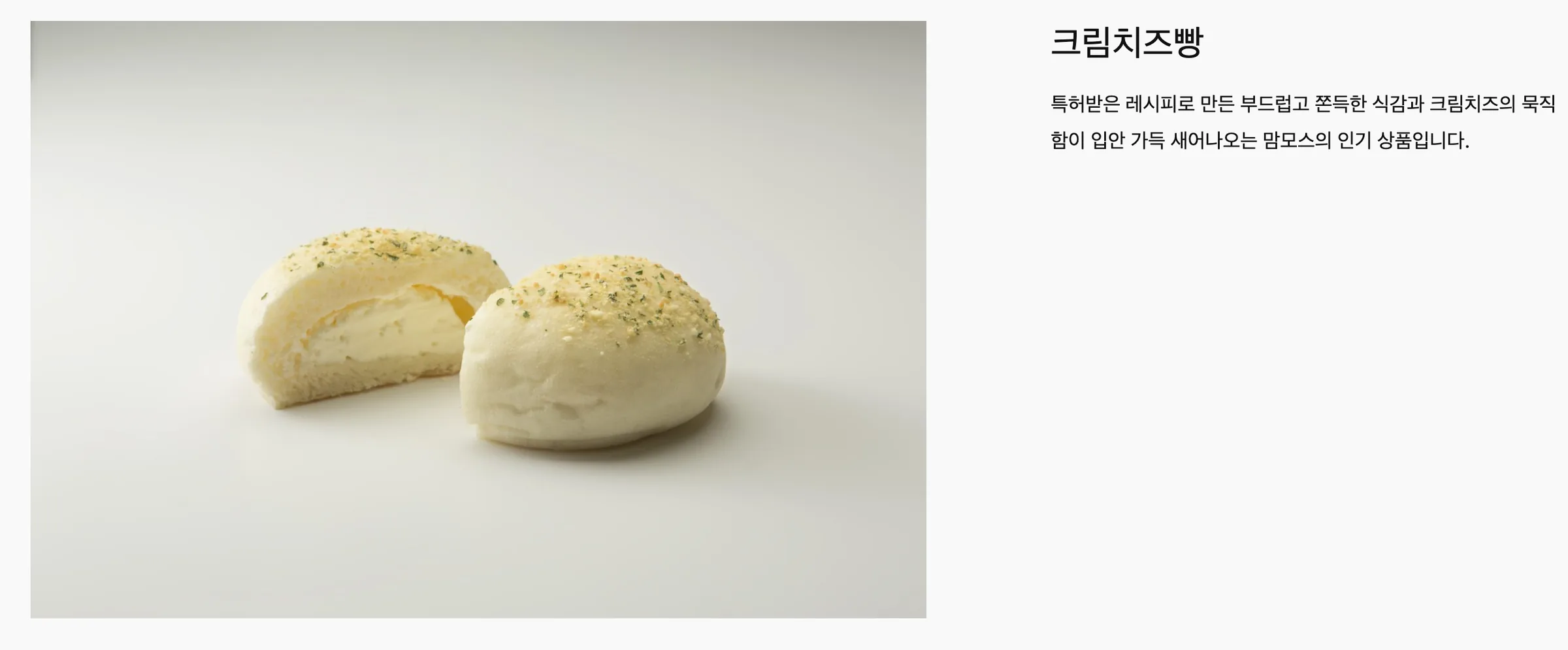
When you reach downtown Andong, there is Mammoth Bakery.
It is a local bakery that began in Andong in 1974.
Andong tourism materials introduce it as a brand that represents the city alongside foods such as salted mackerel and jjimdak. Its signature cream-cheese bun is popular enough that around 5,000 are sold in a day.
There is no need for a long explanation here.
Try one cream-cheese bun.
It is a soft bun filled with cream cheese.
It may seem odd that a cream-cheese bun suddenly appears in a story about a traditional city like Andong.
But travel is like that.
Visiting a historic destination does not mean you must eat only foods from the distant past.
A bakery that local people have loved for decades is also part of the city’s history.
If Hahoe Village represents centuries of Andong,
Mammoth Bakery represents Andong from the 1970s onward.
Both are Andong.
If the cream-cheese buns are already sold out, try something else.
Andong tourism materials also introduce red-bean buns, croquettes and yuja pound cake.
Still, on a first visit, I would pick up the cream-cheese bun first.
Andong without soju would feel incomplete
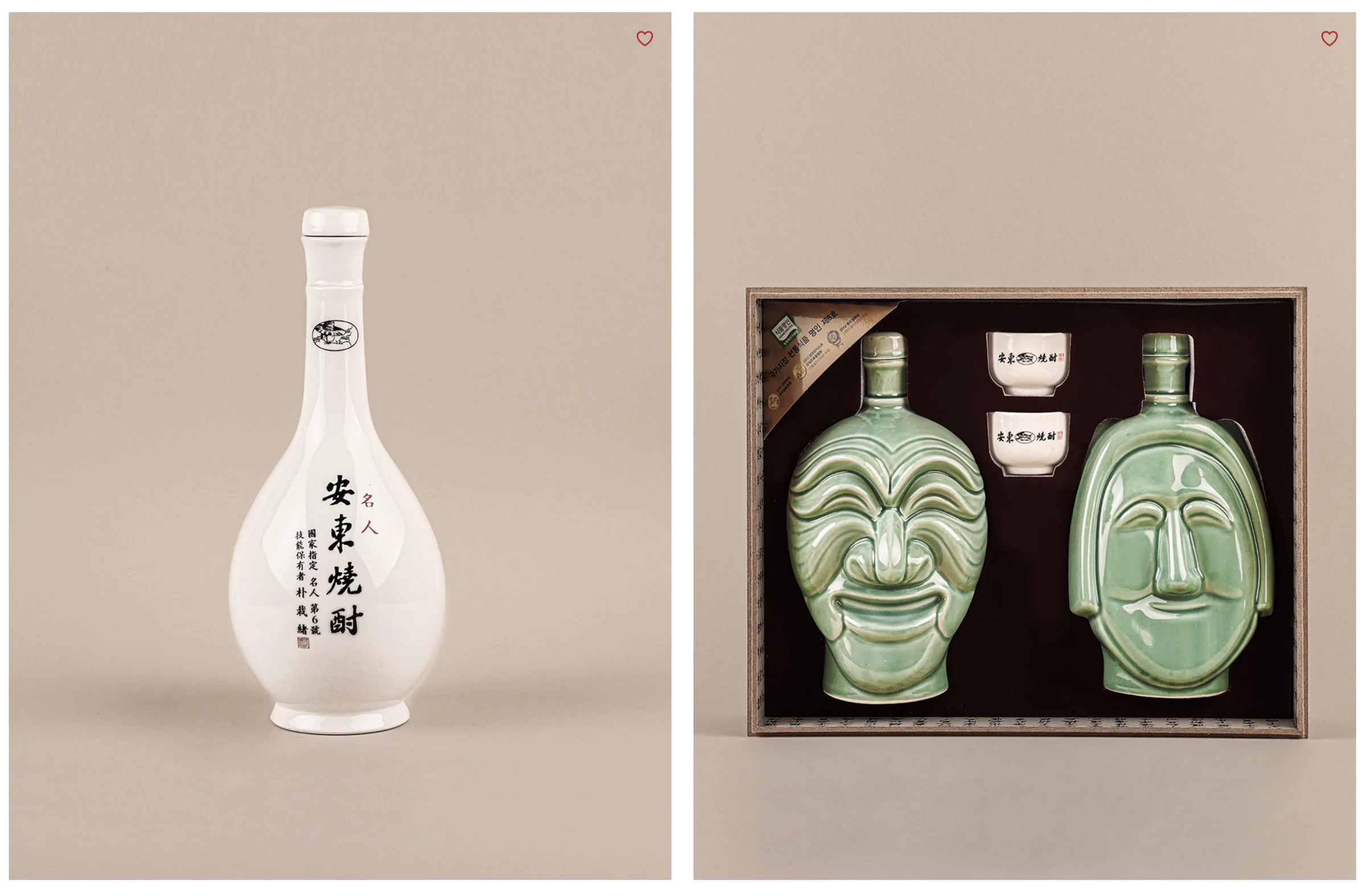
And if you are in Andong, there is Andong soju.
If you have tried Korean soju overseas, you probably picture the familiar green bottle.
Andong soju is quite different in character.
Official Andong tourism information describes it as a distilled rice liquor made by brewing good rice and then distilling the result.
In other words, the alcohol is first fermented and then distilled again.
Alcohol strength and flavor vary by producer and product.
Some traditionally made Andong soju is well over 40% ABV.
Its aroma is stronger too.
You drink it in small amounts.
So if you arrive in Andong, assume it is the same as green-bottle soju, and throw back a large shot, your travel plan may abruptly turn into a sleep plan.
Drink it slowly.
Andong soju is interesting not simply because it is strong.
It pairs very naturally with Andong food.
It works with salty dishes such as salted mackerel,
and with meat or jeon as well.
It is also connected to the regional household culture of brewing alcohol for guests, ancestral rites and family occasions.
So if possible, at least take a look at a small bottle.
If you enjoy spirits, visiting a producer or official shop is another option. Minsokju Andong Soju currently operates a production site and direct sales shop in Andong.
And once again:
If you are using a rental car, drink only after all driving is finished.
The easiest option is to park at your accommodation after the day is over, or simply buy a bottle to take with you.
If Andong soju makes you miss Julbulnori, you have the order completely wrong.
Fire first. Soju afterward.
My recommended two-day itinerary
Now let us put the trip together.
Day 1
Leave Seoul in the morning.
Take the KTX from Cheongnyangni Station.
About two hours later, arrive in Andong.
If possible, pick up the rental car you booked in advance.
Then drive toward Hahoe Village.
Have salted mackerel or heotjesabap for lunch.
Spend the afternoon walking slowly through Hahoe Village.
If you have enough time and a car, continue to Byeongsan Seowon.
Then return to Hahoe Village.
The important thing here is not to get greedy.
On Julbulnori days, crowds gather.
Parking and travel times can take longer than usual.
If you drive far away late in the afternoon just to check off one more attraction and then miss Julbulnori admission, you have lost the point of the entire day.
Come back a little early.
Wait by the river.
The sun sets.
Mansongjeong grows dark.
The outline of Buyongdae slowly disappears.
Then the fire is lit.
One line first.
Then another.
Tiny embers fall over the river.
A boat passes.
Light appears on the water too.
And people shout.
“Nakhwa-ya!”
A large fire falls.
It scatters.
To some, drifting sparks.
To others, falling flower petals.
End the first day with that scene.
Day 2
The next day, see downtown Andong.
If timing works, walk across Wolyeonggyo Bridge.
Then head into the city center.
Eat a cream-cheese bun at the main Mammoth Bakery.
Walk to the old market and have Andong jjimdak.
The area is compact enough on foot that the city of Andong groups it into a downtown food route.
If you want to buy Andong soju, look for it at this point.
See the traditional market,
walk some of the city’s older streets,
and then return the rental car.
Take the train from Andong Station.
By night, you are back in Seoul.
Two days and one night.
It is not long.
Yet you see more of Korea than you might expect.
A Joseon-era village,
a Confucian academy,
an inland fish culture,
market food,
a local bakery,
a distilled spirit,
and finally, people watching fire in a way that has been practiced for centuries.
Andong is not a city displaying “old Korea” behind glass
Andong is often introduced as a city of Korean traditional culture.
That is not wrong.
There is Hahoe Village.
There are seowon academies.
There is Confucian culture.
There is traditional food.
But once you actually travel there, you find that Andong is not only those things.
Jjimdak simmers in the market,
a bakery that opened in 1974 sells thousands of cream-cheese buns a day,
new versions of traditional soju are still produced,
and people reserve tickets every year to watch a fire spectacle that is centuries old.
The old things are not frozen inside a museum.
People are still eating them, drinking them and watching them now.
That is why I like Andong.
You go to see tradition and end up seeing everyday life.
Fireworks usually evolved by becoming bigger
Modern fireworks kept getting larger.
They are launched higher.
More shells explode.
There are more colors.
Music is added.
At festivals attended by hundreds of thousands of people, the entire sky can be filled with light.
That is beautiful too.
But the fire in Andong seems to move in the opposite direction.
It is small.
It is slow.
It brightens for a moment and disappears.
Sometimes there are several seconds of pure darkness.
Then another small fire appears.
That is why you keep watching longer.
You can see a single flame burn.
You can see the speed at which it falls.
You can see it sway in the wind.
You can see the water shake with reflected light.
And when the largest fire falls, someone shouts.
“Nakhwa-ya.”
Watching the fire while hearing that word makes me lose the urge to explain it too neatly.
To some, drifting sparks.
To others, falling flower petals.
Both seem right.
Wait for night
If someone asks where to go in Korea outside Seoul, there are many answers.
There is Busan,
Gyeongju,
and Jeju.
Andong is a little quieter.
It is not a city that overwhelms you immediately.
Hahoe Village is calm during the day.
The Nakdong River simply flows slowly.
So you have to wait.
For the sun to set.
For people to gather by the river.
For the fire to be lit.
And for someone to shout.
“Nakhwa-ya.”
Then fire falls from Buyongdae.
It strikes the rocks.
Countless small lights scatter through the night air.
On the river, that fire blooms once more.
That is the moment I go to Andong to see.
I eat salted mackerel,
jjimdak,
and a cream-cheese bun,
and I pick up a bottle of Andong soju.
I walk through Hahoe Village and visit Byeongsan Seowon.
All of that makes a good trip.
But if you force me to choose only one thing, this is what remains at the end.
Wait for night.
Stand in front of the Nakdong River and watch the fire come alive.
To some, drifting sparks.
To others, falling flower petals.
To me, they are the most beautiful fireworks in the world.
Sources
- Andong Culture FEEL — 2026 Hahoe Seonyu Julbulnori schedule and program
- Andong Tourism official map — KTX from Cheongnyangni to Andong and major travel information
- Andong Tourism — Andong Soju
- Andong Tourism — Downtown food route
- Andong Tourism, Tasty Andong — Mammoth Bakery
- Lotte Rent-a-Car
- SK Rent-a-Car
- Minsokju Andong Soju — production site and direct shop